
A Guide to Flexible Insulin Therapy for Families
This guide is for people with type one diabetes on flexible insulin therapy (not set or fixed insulin at meals).
Whilst this guide can be used to assist you, if you are ever unsure about what adjustments should be made, please speak with your diabetes team at clinic, via the triage section of the DiabHQ app, or via the triage phone service on 6456 1111 (opt. 2).
What is Flexible Insulin Therapy?
Flexible Insulin Therapy, also known as multiple daily injections or MDI, is designed to mimic the normal production of insulin by the pancreas. It is popular because it can provide some flexibility for varying lifestyles.
It consists of a “bolus” of fast-acting insulin before each meal or large snack, with long-acting insulin (Optisulin) given once a day to provide background or “basal” insulin requirements between meals and overnight.
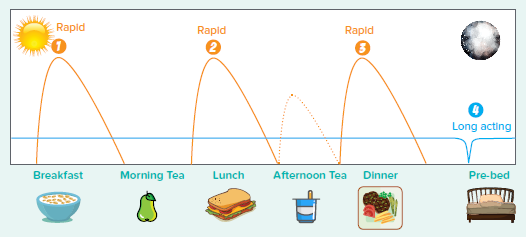
Using flexible insulin therapy with carbohydrate counting will help you to keep your blood glucose levels within range as much as possible. You will be able to adjust your fast-acting insulin to balance the carbohydrate in your meals. It can also help you manage other aspects of everyday life; such as sport, stress or illness.
The amount of fast acting insulin to be given changes based on carbohydrates to be consumed, your insulin to carb ratio and your insulin sensitivity.
What is a carbohydrate ratio?
Insulin to carbohydrate ratio (ICR) is the number of grams of carbohydrates that is covered by 1 unit of insulin. This ratio varies from person to person and can be affected by the time of the day, and changes in weight, age, exercise and other factors.
Below is an example of two different ICR’s applied to the same food.
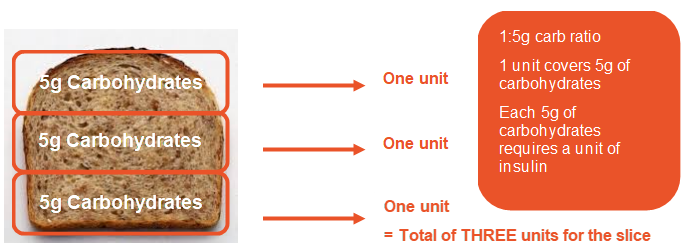
This person uses an ICR of 1:5g
This means each 5g of carbs in this slice of bread requires a unit of insulin. Therefore, this slice of bread which is 15g of carbs needs 3 units.,
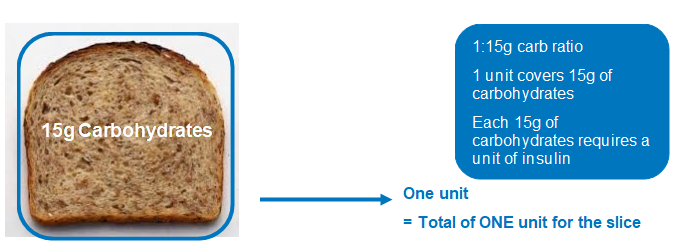
This person uses an ICR of 1:15g
This means 1 unit will cover 15g or the whole slice of bread and the insulin dose will be less than a person with an ICR of 1:5g.
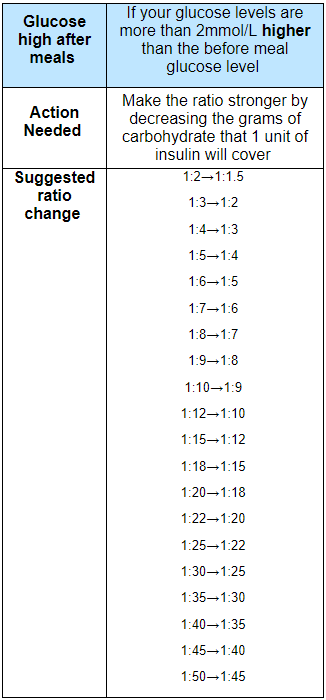
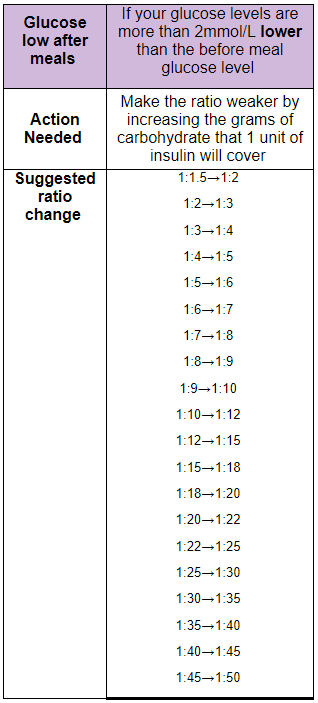
The aim is that 3 hours after a meal, the blood glucose levels should be no more than 2mmol/L higher than before the meal.
Change your Insulin to carb ratio as shown in this table
The smaller the carbohydrate ratio number– the more insulin will be given for food
The larger the carbohydrate ratio number– less insulin will be given for food
What is the insulin correction factor?
The correction factor calculates how much extra insulin should be given for a high blood glucose reading to bring your blood glucose levels back into range (3.9 – 8mmol/L) after 3 hours.
For example, a correction factor of 2mmol/L means that 1 unit of insulin will lower the blood glucose by 2mmol/L. So, if your BGL was 10mmol/L and you injected one unit, your BGL would later be 8mmol/L.
The smaller the correction number– the more insulin will be calculated for a correction dose of insulin
To determine the insulin correction factor the 100 rule is used. First work out the average Total Daily Dose (Optisulin dose plus all rapid acting insulin doses) given over the last five days.
For example: if the average Total Daily Dose of insulin is 50. The calculation is 100 divided by 50. For example 100 / 50units = insulin correction factor of 2.
You can see if the correction factor is correct by looking at the record book or MyLife app log. Look at days when there is a high BGL before a meal and see what happened 3 hours later. You can also look at times when you have had to give insulin without any food to correct a high level. If it over or under corrects, the insulin correction factor needs to be changed.
The MyLife app aims to lower your blood glucose level to 6mmol/L (the middle of the target range 3.9-8mmol/L)
How to change the correction factor is described in the table below.
Remember by making the number lower, you will give MORE insulin.
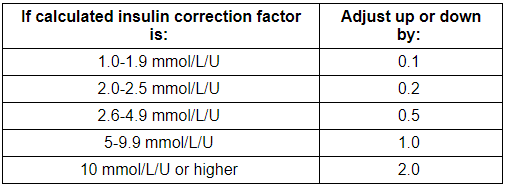
For example, if the current insulin correction factor is 2mmol/L and the BGL is going too low after a correction then change insulin sensitivity to 2.2mmol/L. If the BGL is remaining high after a correction, change to 1.8mmol/L.
Your carb ratio and insulin correction factor should be regularly reviewed. It is important to remember that the blood glucose target is 3.9 – 8mmol/L.
When do I need to change the (Long acting) insulin dose?
The Optisulin dose is long-acting insulin that is active throughout the whole day. This insulin keeps your BGL’s at a relatively stable level between bedtime and the morning.
- If your glucose levels are regularly dropping overnight causing hypoglycaemia without any corrections, then the Optisulin needs reducing.
- If your glucose levels are regularly rising overnight without eating, causing a pattern of glucose levels > 8mmol/L upon waking, you may need to increase the Optisulin.
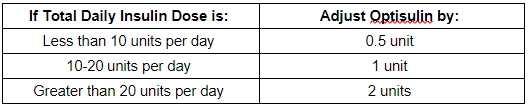
If your Optisulin needs to be changed, calculate the average total amount of insulin given over the last 5 days. This is your Total Daily Dose (Optisulin dose plus all rapid acting insulin doses). Then use the table below to decide how much to change your Optisulin:
Tips for changing insulin
- Look at patterns over three days. Do not change insulin based on one high or low level.
- Look at times of the day separately; different insulin to carb ratios and correction factors across the day is very common.
- Remember target blood glucose levels are 3.9 – 8.0 mmol/L and CGM time in range is between 3.9 – 10 mmol/L.
- Review your glucose levels before and 3 hours after your meals.
- Make sure you are carbohydrate counting correctly before making changes.
- During the “honeymoon phase” your body begins to produce some of its own insulin and insulin requirements can change very quickly. During the “honeymoon phase” changes may be made sooner before the suggested trend of three levels. Please speak to your diabetes team.
If you are unsure, please call the PCH Diabetes team between 8:30am and 4:30pm on 6456 1111 (option 2) and leave a message with your child’s name and your preferred contact number, or you can use the triage section of the DiabHQ app.